Wednesday, August 31, 2011

Old Strings & Bass Players


by Justin Oscar Cary


There's something about bass players that sets them apart from guitar players when it comes to strings. A lot of bassists really dig old, dead strings! I understand why, don't get me wrong: all you have to say is "Jamerson" & that old, thick, funky round-sound comes instantly to mind. James Jamerson reportedly never changed the strings on his iconic '62 Jazz Bass and obviously -it sounded GREAT! I've also heard many stories from bass playing colleagues over the years about a special old set of strings that they value more than the bass they're installed upon... (Actually, I have an old set just like this, I'll wax poetic about that later-) BUT honestly, for me, new strings are a necessity in most professional situations! (Sorry old-school purists, but hear me out before you burn my effigy!)

If I've settled upon an argument for new strings (see below what exactly I mean by "new"). It's probably best summed up thusly: "I can easily make a new string sound convincingly 'old' but I haven't yet found a way to make an old string sound convincingly 'new'!" Yeah, yeah, yeah - I know there's no way to make a brand new string feel and sound exactly like a 20-year old set of flatwounds, but I can get close enough that no one's going to be able to tell above the cacophony of those darned electric guitars! ;-) A little careful EQ (via my homemade "super-secret" passive tone box - details coming soon...) and attentive right hand technique & I can make my freshly-strung Jazz Bass sound old-school in a heartbeat! Plus, I can pivot on my heels and have a bright, modern 'stringy' sound ready to go without ever putting the instrument down! That's the benefit of a fresh string, baby!


...there's always plenty of these lying around!


Now what exactly do I mean about "new" strings? Well, honestly, I usually don't love the sound of bass strings just minutes after installation. I'd estimate it takes me (with my technique and less acidic sweat) an hour or two of playing time on a set of Nickel Roundwounds before I think they're in the 'perfect' state: Bright and modern, but with a full fundamental and stable in terms of tuning. Flatwounds are an exception, in my opinion - they sound great at first, but keep getting better for months! Eventually flats settle into a pretty perfect equilibrium before they just get too stretched out to intonate well. Depending on playing frequency and environmental factors (hot summer festival sets come to mind with sweat pouring all over the poor defenseless strings!), I'll probably change most of my roundwound-strung basses every 3 or 4 months. Flatwounds, on the other hand, last at least 2-3 years or more for me (sometimes, much more!). I love flats, but they just aren't perfect for as many styles/genres/situations as roundwounds are.

As you may already have noticed- I am an enthusiastic D'Addario string endorser! I've been given strings at one point or another by just about every major string manufacturer, but I keep going back to D'Addario's. They have a reliable, very consistent product and make just about any kind of string for any instrument. I use a wide variety of D'Addario's starting with my favorite all-purpose "go-to" XL Nickel Roundwound bass strings. D'Addario Chromes are my flatwound of choice for their incredible stability and bright, scooped tone when settled in. I've just recently started experimenting with D'Addario Half Rounds on my hollowbody Ibanez (see Gear Review: Ibanez AGB140 Bass) & I really dig them!


I've also switched over to a new product on my acoustic bass guitar: D'Addario EXP Reds coated copper-plated strings (available soon): An outstanding coated string with a distinct "earthy" sound! Watch for a column on my heavily modified Epiphone Rivoli using D'Addario Black Nylon Tapewounds, they really should be the standard string on any short-scale hollowbody bass! I also use a variety of other D'Addario guitar strings such as Pro-Arte' classical nylon strings, EXP 16 coated acoustic strings and various XL Nickel Roundwounds for electric guitars.

There's only one special case in my instrument arsenal that has "old" strings on it - a 1978 Fender maple-board fretless. For whatever reason, the decades old monel-steel flatwound strings that came on it just work great on that particular instrument. I actually re-strung the bass when I bought it, played it with the new strings for a couple of days & then fished the old strings out of the trash! There's just some weird x-factor with that bass & those old, dirty strings that works best.

Bottom line? New bass strings just have more tonal options than old bass strings. In an industry that demands a chameleon-like ability to jump from old-school to new-school sounds at the drop of a hat, new strings make it possible!

Friday, July 29, 2011

Let's Have A Party!

Summer NAMM in July. 95 degrees in Nashville, Tennessee. Sounds like a good enough reason to throw a BBQ party, so we did.

On July 20th, D'Addario held a Grand Opening party for our Nashville Artist Relations office, located in the Soundcheck Annex building. Invitations were sent to all of our dealers who were in town for the NAMM show and all of our endorsers within a three-state area.

Over 450 people attended, enjoying Jack's BBQ, local Yazoo beer and the great music of Elizabeth Cook, Stephen Mougin's Bluegrass All-Stars, Webb Wilder and the Kenny Vaughan Trio.


Elizabeth Cook


Stephen Mougin's Bluegrass All-Stars


Webb Wilder


Kenny Vaughan Trio

Monday, June 27, 2011

2011 Salmanca Classical Guitar Festival

Hi there, this is Thomas Offermann from the 1st Certamen Internacional de Guitarra Clásica Heitor Villa-Lobos! A few hours ago the first round with 39 applicants ended.

The level of the competition – even of the first round – is incredibly high, and the Jury had to eliminate a lot of wonderful players all of us would have loved to hear in the second round. But after a very good and long discussion we agreed to only let those competitors pass to the semifinal who have a real chance to finally end up as finalists or even winners of this competition:

Marko Topchyi
Marlon Titre
Noriyuki Masuda
Rafael Aguirre
Rovshan Mamedkuliev
Tal Hurwitz
Alejandro Córdova

This will be a very tough semifinal!

Sometimes it is really hard to work as a juror, ending up with cruel decisions; and this morning was like that. Some of those who couldn’t pass will with no doubt win other competitions! In the end the Jury, consisting of Hugo Geller, Ernesto Bitetti, Carles Trepat, Luis Paulo Horta and me, tried to do a very honest job.

Salamanca is a fantastic place for a competition of this prominence: with about 150.000 inhabitants, situated not far from the Portuguese border in Spain, Salamanca has a first rank university and is a vivid and attractive place to visit and to stay.

Prof. Thomas Offermann
D'Addario Artist Relations


Villa-Lobos Concierto performance


Thomas & D'Addario artist Rafael Aguirre


Thursday, June 23, 2011

Jim D'Addario Visits Washington, DC

As many of you know, I have been very active in combating the growing number of counterfeit products being sold worldwide and also protecting composers’, musicians’, authors’ and screen writers’ intellectual property.

Over the last 20 years, we have noticed a steady increase in the quantity of counterfeit guitar strings available globally. Initially, the quality of the packaging alone was so poor that it was easy to spot a fake set. Then over time, as more and more U.S. companies off-shored their manufacturing to emerging markets like China, the quality of Chinese-sourced packaging improved to the point where it is now difficult for even D’Addario product specialists to tell a real package from a fake package. Unfortunately, while great attention is paid to the packaging quality, the product inside has not improved very much.

The problem is not unique to D’Addario strings; every major string brand is being counterfeited. Copying a product, marking it with the proper country of origin and marketing it under a different brand name is fair trade. Counterfeiting someone’s packaging exactly, using their registered trademarks and marking the product “Printed and Made in U.S.A.” when it is made in China is criminal activity.

The problem is not unique to the music accessory business. Some of you my age might remember the lyric from The Band’s ‘Life is a Carnival’, “Hey buddy, would you like to buy a watch real cheap, here on the street? I’ve six on each arm and two around my feet.” We all thought it was humorous to buy a fake Rolex for $25 back then. What was good for a chuckle 35 years ago is not a laughing matter anymore.

Recent survey results compiled in an International Trade Commission survey just released (http://www.usitc.gov/publications/332/pub4226.pdf) shows that 2.1 million jobs in America are being lost to counterfeit trade. Almost every single industry is involved; and counterfeit products in industries such as pharmaceuticals and semiconductors, for instance, pose very serious public safety concerns.
Enter NAMM.

Towards the end of 2010, NAMM, on behalf of the many NAMM members being affected, took a keen interest in advocating for reform on this issue. At the NAMM Show in January of this year, NAMM hosted a well-attended Music and Sound Intellectual Property Task Force Meeting, attracting over 100 NAMM, PAMI (ProAudio) and InfoComm members.

In mid-May, NAMM organized a Washington DC ‘Fly In’ advocacy trip where over 50 NAMM members, including myself, teamed up to visit congressmen and senators to advocate on two very important issues: music education and intellectual property protection. The trip was a huge success.

Personally, my lobbying team had 14 meetings scheduled on May 11. We had to split up to cover them all. We had the pleasure of meeting with Senators Richard Blumenthal and Scott Brown and Congressmen Tim Bishop, Steve Israel, Peter King and Ted Poe, just to mention a few. Overall, there was strong bi-partisan support for more intellectual property protection and music education.

The trip ended on Wednesday night with a NAMM-hosted reception in the Capitol building, with special guests Tony Bennett, pianist, singer/song-writer Gavin DeGraw, and Bernie Williams.

The highlight of the trip for me was getting to sit next to New York Yankees World Series Champion Bernie Williams at the congressional reception. Bernie is a fine guitarist and an incredible human being. He put three days aside to attend our NAMM meetings and visits on Capitol Hill.

If you have concerns about the effects of reduced music education funding and rampant intellectual property theft affecting our economy and the future of our nation, please take the time to write to your representatives. It’s easy to locate their websites where you can drop them an email. If enough of us speak up, they will listen.
Sincerely,
Jim D'Addario

P.S. – Check out some photos from the WDC trip. . . .

Jim D’Addario with Tony Bennett and Congressman Steve Israel. Steve represents the district where D’Addario’s NY headquarters is located and has been a tremendous advocate on our behalf.

Jim D’Addario with Tony Bennett

Tony Bennett with Congressman Steve Israel and Congressman Tim Bishop

Jim D’Addario with Bernie Williams and Joe Lamond, President & CEO of NAMM

Sunday, May 22, 2011

CAGED - Uncaged

I've been playing guitar for 37 years now, and collecting books and videos on the subject for nearly as long. With the advent of eBay, I've been able to go back and re-buy relics from my formative years - old Mel Bay chord books, Pat Thrall's "Improvising Rock Guitar ( an early attempt at teaching Rock), and even earlier kitschy volumes like Ed Sale's "The Guitarists' Book of Knowledge". I have a nice collection and from time to time I thin it out with loaners or giveaways to friends and family.


The other day a friend stopped by to help re-configure my studio computer and was asking if I had anything he could work on to get him out of a rut. He's a hobby guitarist who played enough to get decent and now wants to learn more. Everything he knows he figured out by ear, at random moments in time. Without an overall approach or method, he has gaps in is knowledge that frustrate him and while he can HEAR what he wants to play, he does not always know where it is on the neck.


I gave him my copy of Bill Edwards' "Fretboard Logic", a modern take on the classic CAGED system. I think my first exposure to it was a 1986 Guitar Player magazine article with Joe Pass. This approach to organizing the fretboard was news to him and after a few minutes of demonstration, light bulbs were popping and it was great to see and hear his enthusiasm. It was like he finally had a set of keys to ALL of the closed doors.


The great thing about the CAGED method is that it is style-free. It does not matter if you are playing Classic Rock, Jazz or Hip-Hop, the method applies. There are tons of YouTube videos exploring this concept, in addition to the video series at Guitar.com. Once you start to see the spatial and harmonic relationships - and the differences - the style of music does not matter... only the Music.

Thursday, March 31, 2011

Fat-Bottomed URLs

A few of observations regarding my week at SXSW: First, Rock is alive and well, if not on your local radio dial. I saw roots bands, funk bands, metal bands, Americana bands, soul bands. I liked all of them. The whole trip was worth it if only to see so many good bands, playing good songs on good instruments.

Second, by far the most popular style of guitar that I saw was the semi-hollow body: Epiphone Sheratons and Casinos, Gibson ES-330, Es-335, ES-125 and their many variations. Jazz Metal monster Alex Skolnick was playing a full-sized Heritage. Intersting trend.

Third, heavier strings are the most popular. Down-tuning is no doubt a large part of it, but we were giving out free sets of strings to attendees that joined our mailing list, and had very few requests for electric .009 gauge strings at our booth. This might be a good time to remind y'all about the sets D'Addario offers in the more hefty gauges:


Two sets in the "Medium Top-Heavier Bottom" category. The EXL116 is essentially the perennial favorite EXL115 set's E, B and G strings with a beefier D, A and low E. The EXL117 gets heavier starting with the G string.


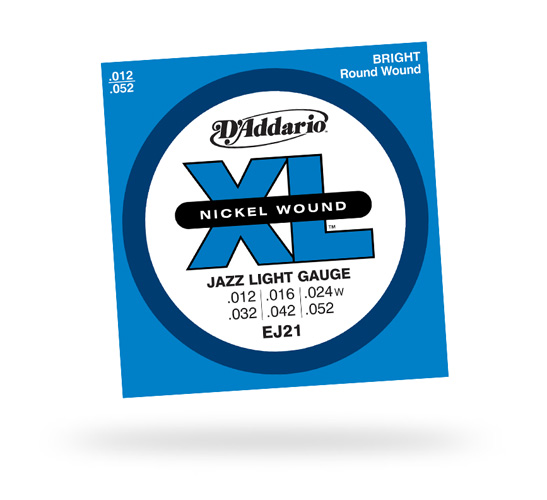
If you want a more balanced set, you can try the EJ21 set. It has a wound G string, great for rhythm tracks.


If you still want to bend that G, try the EXL145 set. It has a plain G and a heavier low E. Once you try some of our pre-made sets, you can swap out various gauges and make up your own custom set using our single strings.


Check out more string gauges at www.daddario.com.

Friday, February 11, 2011

Who's Your DADGAD?

Altered tunings. While that might describe the un-processed vocal tracks of the latest Super Bowl festivities, in guitardom it means changing your tuning from the standard EADGBE to something a bit more exotic. Intrepid acoustic guitar explorers might start by dropping their Low E down to D at first, in order to get some depth in their accompaniment. That can lead to dropping the Hi E to D as well, and thus the drop D gateway drug leads you to DADGAD or the endless variations thereof. My first conscious exposure to altered tunings was trying to play "Kashmir" in standard. In can be done, but not as easily as in DADGAD.

There are a host of guitar players who tune to DADGAD and have made it part of their signature sound doing so, such as Pierre Bensusan and Laurence Juber .


D'Addario strings have always sounded great in alternate tunings, but it took some getting used to the different feel and tension of a slacked string intended for standard tuning. The new EJ24 True Medium set addresses this by using a smaller core wire in the 3rd, 4th and 5th strings.


Diameter Tension
Item# Note inches mm lbs kg
PL013 E 0.013 0.33 27.4 12.42
PL017 B 0.017 0.43 26.3 11.91
PB024 G 0.024 0.61 30.2 13.38
PB032 D 0.032 0.81 30.5 13.83
PB042 A 0.042 1.07 29.9 13.56
PB056 E 0.056 1.42 29.0 13.15

These strings have an even-feel tension in both standard and DADGAD tunings. String up your acoustic with the EJ 24 set and DADGAD it.